Solar Panel Maintenance: The Complete Annual Checklist (2026)
A full year of solar panel maintenance costs 3 to 4 hours of your time and $0 to $400. This printable 12-month checklist, built from Hongyu’s internal data, captures the routine that prevents most claims, including the five inspections homeowners skip until a small issue becomes a $1,500 repair.
Key Takeaways
- A complete annual solar panel maintenance routine costs 2 to 4 hours of your time and $0 to $400 per year (mostly cleaning service fees).
- Skipping maintenance does not break panels immediately. It compounds small issues (loose clamps, lifted flashing, rodent damage) into $1,500+ repairs over 3 to 5 years.
- The 5 critical checks most homeowners skip: rapid-shutdown device test, inverter firmware update, ground-fault test, conduit rodent inspection, and per-panel monitoring review.
- Hire a licensed electrician for the 5-year inspection ($200 to $400). Everything else is DIY.
Table of Contents
- Why proactive solar panel maintenance matters
- The annual solar panel maintenance schedule (12 months)
- January — Annual review (45 minutes)
- February — Quiet month (skip if nothing flagged)
- March — Spring kickoff (60 minutes)
- April — Roof inspection (45 minutes)
- May — Production benchmark (15 minutes)
- June — Quiet month
- July — Mid-year cleaning (60 minutes if arid region)
- August — Wildfire smoke check (variable)
- September — Quiet month
- October — Fall preparation (60 minutes)
- November — Inverter health (30 minutes)
- December — Documentation (30 minutes)
- Every 5 years: the professional electrical inspection
- Annual solar panel maintenance time and cost budget
- What tools do you need for solar panel maintenance?
- How to keep a solar panel maintenance log (warranty proof)
- The 5 maintenance tasks most homeowners skip
- Frequently Asked Questions
- How often do solar panels need maintenance?
- What does annual solar panel maintenance cost?
- Do I need a professional for solar panel maintenance?
- What happens if I never maintain my solar panels?
- Can I void my solar panel warranty by maintaining it wrong?
- What is the most important annual maintenance task?
- How long should I keep maintenance records?
- Should I maintain solar panels myself or hire a service?
- What is the difference between solar panel maintenance and solar panel repair?
- Sources and references
- Related guides
Why proactive solar panel maintenance matters
NREL’s reliability data shows median degradation of 0.5% per year on well-maintained systems. Systems with skipped inspections degrade 2 to 3 times faster, mostly because small issues compound:
- A loose mounting clamp lets a panel shift, eventually cracking the glass on a windy day
- Lifted roof flashing lets water in, rotting the underlayment and shorting wiring
- Rodent-chewed conduit shorts the array offline for weeks before you notice
- Outdated inverter firmware leaves known production bugs unpatched
These do not happen in year 1. They show up in years 3 to 7, exactly when most homeowners assume the system is fine because the warranty has not yet expired.
For the full lifespan and degradation context, see the solar panel maintenance guide and the degradation rate breakdown.
The annual solar panel maintenance schedule (12 months)
Print this and place it in a spot you will notice regularly, such as next to your breaker box. Block 30 minutes per checked month on your calendar.
January — Annual review (45 minutes)
- Pull last year’s monitoring data into a spreadsheet
- Compare year-over-year output by month under similar weather
- Note any single-panel underperformers (open per-panel data in your inverter app)
- Renew monitoring subscription if applicable
- Photograph the array from the ground for year-over-year visual comparison
February — Quiet month (skip if nothing flagged)
If January raised no flags, no action. If a solar panel underperformed, schedule a professional inspection now before spring weather hits.
March — Spring kickoff (60 minutes)
- Hose-rinse panels after first pollen wave (see how to clean solar panels)
- Visual check from ground for cracked glass or lifted clamps
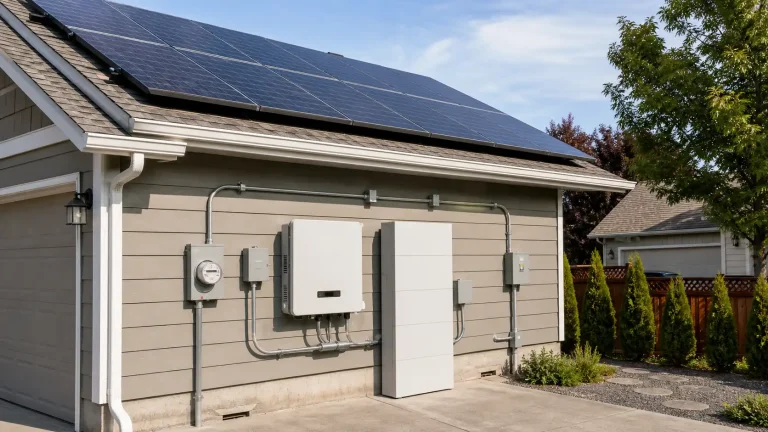
- Clean dust off inverter ventilation fins with a dry brush
- Walk the conduit run, look for chew marks or pinch points
April — Roof inspection (45 minutes)
- Inspect roof flashing around mounts after winter thaw
- Look for any water staining on attic ceiling under the array
- Test rapid-shutdown device button if your system has one
- Trim any tree limbs that grew into the array’s solar window
May — Production benchmark (15 minutes)
- Record May’s energy output as your spring baseline for future comparison.
- Confirm monitoring app shows expected kWh given local irradiance
- Flag any clouds-adjusted shortfall greater than 10%
June — Quiet month
If May benchmark was clean, no action. Solar is producing peak output now.
July — Mid-year cleaning (60 minutes if arid region)
- Second cleaning if you live in Southwest, Central Valley, or high desert
- Visual check for thermal expansion damage at mount points
- Clear any vegetation now shading the array
August — Wildfire smoke check (variable)
- Track local AQI. If heavy smoke event occurs, schedule a cleaning within 30 days
- Photograph any ash deposit before cleaning for insurance reference
September — Quiet month
Same as June. Confirm energy production looks normal.
October — Fall preparation (60 minutes)
- Pre-winter cleaning to remove summer dust and leaves
- Check rapid-shutdown device test button
- Inspect critter guard for damage; replace galvanized mesh if rusted
- Confirm snow rake is foam (not metal), accessible, and intact
November — Inverter health (30 minutes)
- Update solar inverter firmware via manufacturer app or installer portal
- Check inverter event logs for any warnings ignored during the year
- Note inverter age and start budgeting replacement if past year 8 (string inverters)
December — Documentation (30 minutes)
- Log every action from this checklist in your maintenance file
- File any photos, screenshots, or service receipts
- Prepare the annual report for your records (warranty claims require this)
Every 5 years: the professional electrical inspection
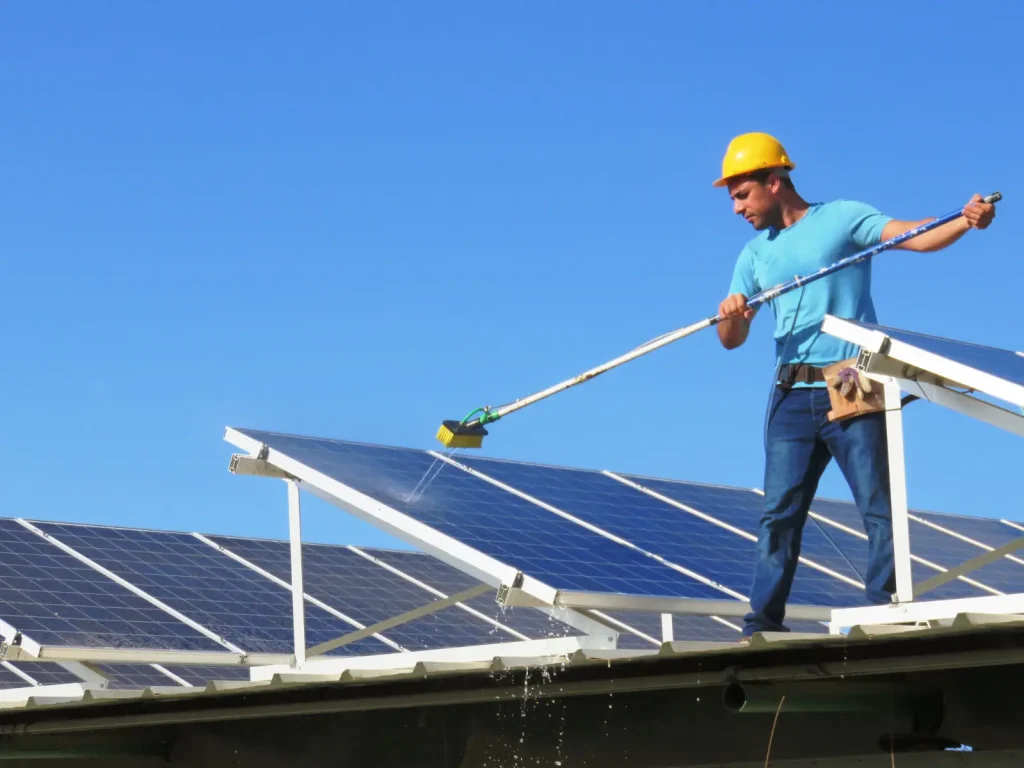
Hire a licensed electrician with PV experience (NABCEP certification is the gold standard). Cost: $200 to $400 as of May 2026. The pro inspection covers what you cannot test safely from the ground:
- Ground-fault circuit interruption test
- DC and AC wiring continuity
- Combiner box and junction box thermal scan (catches corrosion before it sparks)
- Inverter capacitor health
- Rapid-shutdown device live test
- Conduit interior inspection for rodent or moisture damage
Most warranties require documented inspections every five years to remain valid after year 10. Keep both the receipt and the inspection report. To find a certified inspector, contact your original installer or ask the seller who supplied your system.
Annual solar panel maintenance time and cost budget
| Item | Time | Cost (May 2026) |
|---|---|---|
| DIY cleanings (2–4 per year) | 2–4 hours | $0–$50 in supplies |
| Pro cleaning (alternative) | 30 min waiting | $150–$330 |
| Visual inspections | 2 hours total | $0 |
| Inverter firmware updates | 30 min | $0 |
| 5-year electrical inspection (amortized) | 2 hours every 5 years | $40–$80/year average |
| Critter guard replacement (every 8 years) | — | $50/year amortized |
| Monitoring subscription | — | $0–$10/month |
| Total typical year | 3–4 hours | $80–$200 |
| Total intensive year (with pro cleaning) | 2 hours | $300–$500 |
Compare that to repair costs from neglect: a single rodent-damaged conduit run averages $300 to $1,200; an inverter that fails out of warranty runs $1,500 to $3,500. The math favors maintenance.
For the full repair price list, see solar power maintenance costs.
What tools do you need for solar panel maintenance?
Build a maintenance kit once, reuse for 20+ years:
| Tool | Purpose | One-time cost |
|---|---|---|
| Soft long-handled brush | Cleaning, debris removal | $15–$25 |
| Garden hose flow nozzle | Cleaning rinse | Owned |
| 5-gallon deionized water jug | Streak-free final rinse | $8–$12 per refill |
| TDS meter | Confirm tap water hardness | $12 |
| Foam roof snow rake | Winter snow clearing | $35 |
| Soft-soled work shoes | Rooftop safety | $40 |
| Maintenance log notebook or app | Warranty documentation | $0 |
| Bird-deterrent critter guard | Hot-spot prevention | $300–$500 (installer) |
What not to buy: pressure washers, metal brushes, harsh chemical cleaners, or ladder-mounted hose extensions. These products can cost more and may void your warranty.
How to keep a solar panel maintenance log (warranty proof)
Tier-1 solar panel manufacturers require documented maintenance for full warranty coverage past year 10. A simple log saves your warranty claim:
For each entry, record:
- Date of the action
- Action taken (cleaning, inspection, firmware update)
- Findings (clean / soiled / damage noted)
- Photos from the same vantage point each time
- Receipts for any paid services
Use paper, a spreadsheet, or your phone to record each inspection and maintenance task. Keeping clear, consistent records gives you stronger documentation and better protection if you ever need warranty or service support.
The 5 maintenance tasks most homeowners skip
These are the ones that actually catch expensive problems:
- Rapid-shutdown device test. Push the test button annually. A failed device prevents firefighter shutoff during a roof fire, which is a code violation.
- Inverter firmware updates. Manufacturers patch production bugs and safety issues every 6 to 12 months. Schedule November.
- Ground-fault circuit interrupt test. Done by the licensed electrician at the 5-year inspection.
- Conduit interior check. Rodents chew wires inside conduit, invisible from outside. Open junction boxes during the pro inspection.
- Per-panel monitoring review. Your inverter app shows individual panel output. Most homeowners only watch system total, missing single-panel failures for months.
Frequently Asked Questions
How often do solar panels need maintenance?
Most residential solar energy systems need 3 to 4 hours of homeowner time per year, plus one professional electrical inspection every 5 years. Cleaning frequency varies by region: 1 cleaning per year in rainy climates, 3 to 4 in arid regions.
What does annual solar panel maintenance cost?
A typical year runs $80 to $200 in supplies and amortized pro inspection costs. Intensive years with paid cleaning run $300 to $500. Compare to $1,500+ for repairs from neglect.
Do I need a professional for solar panel maintenance?
Most maintenance is DIY: cleaning, visual inspection, firmware updates, log keeping. Hire a licensed electrician every 5 years for the deep electrical inspection ($200 to $400).
What happens if I never maintain my solar panels?
The system continues producing power but degrades 2 to 3 times faster than well-maintained systems. Small issues (loose clamps, rodent damage, lifted flashing) compound into $1,500+ repairs in years 3 to 7. Tier-1 warranties also require documented inspections past year 10.
Can I void my solar panel warranty by maintaining it wrong?
Yes. Pressure washing voids most Tier-1 warranties, including Hongyu HY-Series. Walking on panels can crack cells. Using soap or harsh chemicals voids surface warranties. Stick to the safe routine in how to clean solar panels.
What is the most important annual maintenance task?
Review your monitoring app monthly and act on any year-over-year drop greater than 5% with no weather explanation. Catching problems early is worth more than any single physical inspection.
How long should I keep maintenance records?
For the life of the warranty, typically 25 years. Tier-1 manufacturers require documented inspections for claims past year 10. Digital photos and a simple log are enough.
Should I maintain solar panels myself or hire a service?
Most homeowners save $150 to $500 per year by doing visual inspections, cleaning, and firmware updates themselves. Hire a pro for the 5-year electrical inspection and any cleaning where roof pitch exceeds 4/12.
What is the difference between solar panel maintenance and solar panel repair?
Maintenance is preventive (cleaning, inspection, updates). Repair is reactive (replacing failed parts after a problem). The full repair cost list is in solar power maintenance costs.
Sources and references
- NREL (2023). PV Module Reliability Benchmark. Median degradation 0.5%/year on maintained systems, 1.0–1.5%/year on neglected.
- NABCEP (2024). Certified PV Installation Professional Standards. https://www.nabcep.org/.
- IEC (2021). IEC 61215: Terrestrial photovoltaic modules – Design qualification and type approval. https://webstore.iec.ch/en/publication/61345.
- NFPA (2023). NEC 2023 Article 690 and 690.12 (Rapid Shutdown). https://www.nfpa.org/codes-and-standards/all-codes-and-standards/list-of-codes-and-standards/detail?code=70.
- Hongyu Solar (2026). HY-Series Limited Warranty, Section 4.2 (maintenance documentation requirements).
Related guides
- Solar Panel Maintenance: Cleaning, Lifespan & Repair Guide
- How to Clean Solar Panels (Step-by-Step DIY)
- Solar Power Maintenance Costs Explained
- How Long Do Solar Panels Last?
- Solar Panel Wiring Issues Troubleshooting
- Solar Panel Degradation Rate Explained
Disclosures
- The checklist applies to any UL-listed, IEC 61215-certified panel.
- Pricing figures reflect May 2026 US market averages. Final pricing varies by region, labor market, and system size.
By Peter: Peter is a Senior PV & Energy Storage Engineer at Hongyu Supply Chain. As a seasoned expert in the renewable energy industry, he focuses on solar power generation, smart energy storage systems, and clean energy supply chains, delivering valuable technical analysis and industry trend insights to global audiences.