Solar PV Panel Comparison: Types and Buying Factors (2026)
Solar PV panel comparison is easier when you separate three choices: cell material, cell architecture, and module construction. Hongyu Solar is a solar panel manufacturer, so this guide compares those choices through published specifications, certifications, warranties, roof fit, and quote terms.
Key Takeaways
- In 2026, crystalline silicon made up 98% of PV module production.
- For most homes, start with a certified monocrystalline n-type module.
- Bifacial modules need real rear-side light. A dark, flush roof may not deliver it.
- Compare the exact model, warranty, temperature coefficient, and installed design before price.
Table of Contents
- What are you actually comparing?
- Which panel materials fit each use case?
- Monocrystalline silicon
- Polycrystalline silicon
- Thin film, flexible PV, and building-integrated options
- How do PERC, TOPCon, HJT, and IBC differ?
- When does bifacial technology help?
- Which specifications predict output?
- How should you compare quotes in 2026?
- What should installers and procurement buyers verify?
- Which technologies are worth watching?
- Frequently Asked Questions
- What type of solar panel is best for a typical home?
- Are TOPCon panels better than PERC panels?
- Are bifacial solar panels worth it on a house?
- Is a higher-efficiency solar panel always better?
- How long do solar panels last?
- Can a homeowner claim a federal solar tax credit in 2026?
- Do black solar panels produce more electricity?
- Should I wait for perovskite or tandem solar panels?
- Make the decision with a quote sheet, not a label
- Sources and reference records
What are you actually comparing?
In 2026, global module production reached 706GW and crystalline silicon accounted for 98% of output. That means most homeowners compare versions of silicon modules, not unrelated technologies. The useful distinction is material, cell architecture, and module construction.
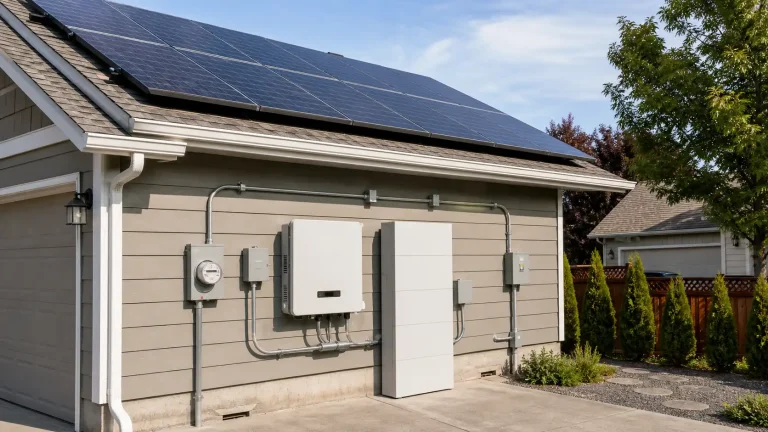
A panel is a protected module of interconnected PV cells. The module produces DC electricity. A complete system also needs racking, wiring, solar inverter, electrical protection, and an approved connection to the home and utility.
The same proposal can contain all three layers of choice:
- Material describes the light-absorbing semiconductor. Common examples are monocrystalline silicon, older polycrystalline silicon, and thin-film materials.
- Cell architecture describes how the silicon cell collects and manages charge. PERC, TOPCon, HJT, and IBC are architecture labels.
- Module construction describes the finished product. A module can be monofacial, bifacial, flexible, glass-glass, or integrated into a building surface.
This three-layer view prevents a common buying mistake. TOPCon is not a fourth material beside mono, poly, and thin film. A typical TOPCon residential module is still a monocrystalline silicon product. Bifacial is also not a cell material. It describes a module designed to collect light from both sides.
Keep the terms separate in every quote: photovoltaic describes the electricity-generating effect, while a panel is the finished module installed on the roof.
Which panel materials fit each use case?
In 2026, monocrystalline silicon represented 96% of global solar shipments, while industrial silicon modules commonly achieved 20%-22% real-world efficiency. For a space-constrained home roof, monocrystalline silicon is usually the sensible starting point because it produces more capacity per usable area.
Monocrystalline silicon
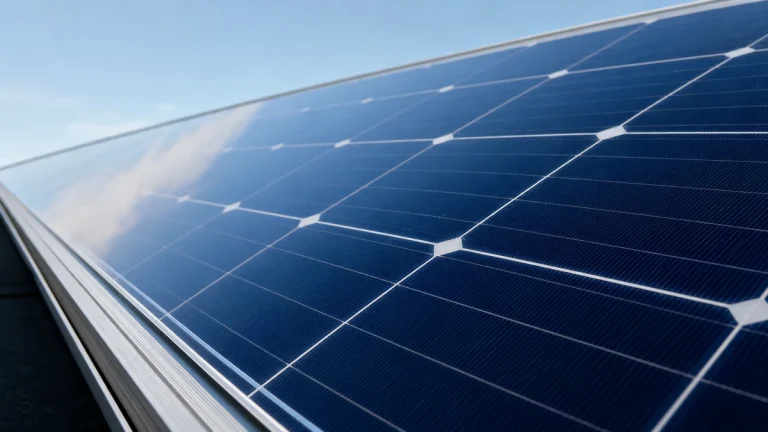
Monocrystalline modules use wafers made from a single crystal structure. They are usually dark in appearance and dominate current residential offers. Their value is not a color or a premium label. It is the ability to place more DC capacity on a limited roof when the installed design supports it.
Polycrystalline silicon
Polycrystalline modules use many crystal structures. They were once a common value option. For a new U.S. home project, they appear less often because the price gap narrowed while monocrystalline performance improved. They can remain relevant for an existing-system match or a verified low-cost offer with sufficient roof area.
Thin film, flexible PV, and building-integrated options
Thin-film PV can use materials such as CdTe or CIGS. The U.S. Department of Energy notes that thin-film materials can be cost-effective but generally have lower module efficiency than silicon. Flexible PV and solar shingles are therefore fit-for-purpose products, not default substitutes for a conventional rooftop module.
Use this basic material decision rule:
| Use case | Starting point | What to verify |
|---|---|---|
| Small, simple home roof | Monocrystalline silicon | Efficiency, dimensions, temperature coefficient |
| Large roof with lower space pressure | Compare available mono offers | Total installed cost and warranty support |
| RV, boat, curved, or weight-sensitive surface | Flexible PV | Electrical limits, mounting method, heat, and durability |
| Architecture-led project | Solar shingle or BIPV | Serviceability, output per usable area, roof cost, warranty issuer |
| Utility-scale or unusual commercial site | Technology-specific study | Project engineering, land use, and interconnection |
Start with usable roof area. A low module price cannot solve a roof that lacks enough clear, code-compliant space. Conversely, an ultra-high-efficiency offer may not earn its premium on a large, unshaded roof.
How do PERC, TOPCon, HJT, and IBC differ?
In 2026, TOPCon cell market share rose from 30% to 70%, and n-type wafers became the dominant technology. For a new residential quote, TOPCon is a current baseline to compare. It does not make every TOPCon model automatically better than every PERC, HJT, or IBC module.
PERC adds a passivated rear surface to a silicon cell. It became the mass-market successor to earlier aluminum back-surface field designs. PERC modules can still be reliable when their exact model, warranty, and certification are appropriate. However, the industry is moving toward n-type architectures.
TOPCon adds a thin tunnel oxide and passivating contact structure. That design can improve charge collection and supports the shift toward n-type wafers. It is now widely available, which makes product-level comparison more important than technology hype.
HJT combines crystalline silicon with thin amorphous-silicon layers. It can offer attractive temperature behavior and degradation characteristics, but the installed value depends on the module, supplier support, and price. IBC moves metal contacts to the rear of the cell. That reduces front-side shading from gridlines, but its manufacturing complexity limits its market share.
The practical comparison is short:
- PERC: established architecture. Compare its price and warranty against current n-type alternatives.
- TOPCon: mainstream n-type baseline for new offers. Verify exact module data and warranty terms.
- HJT: specialized n-type option. Compare temperature behavior and price with actual datasheets.
- IBC: advanced rear-contact design. Treat it as a model-specific choice, not a general quality tier.
When does bifacial technology help?
In 2026, bifacial modules reached 77.6% of Chinese production. That production share shows how common the construction became. It does not prove that a bifacial module will add meaningful output on every residential roof.
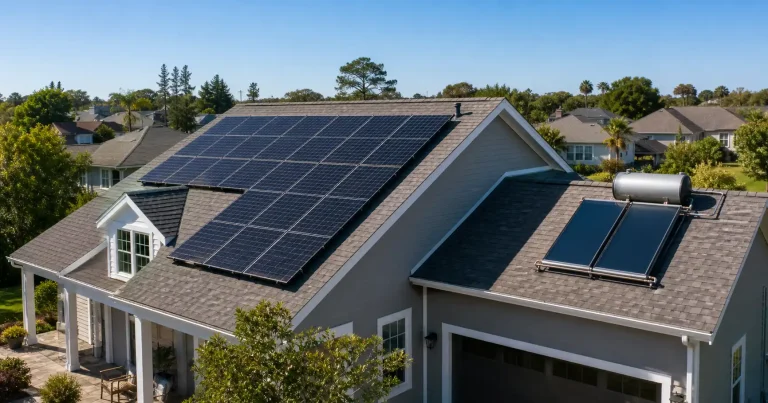
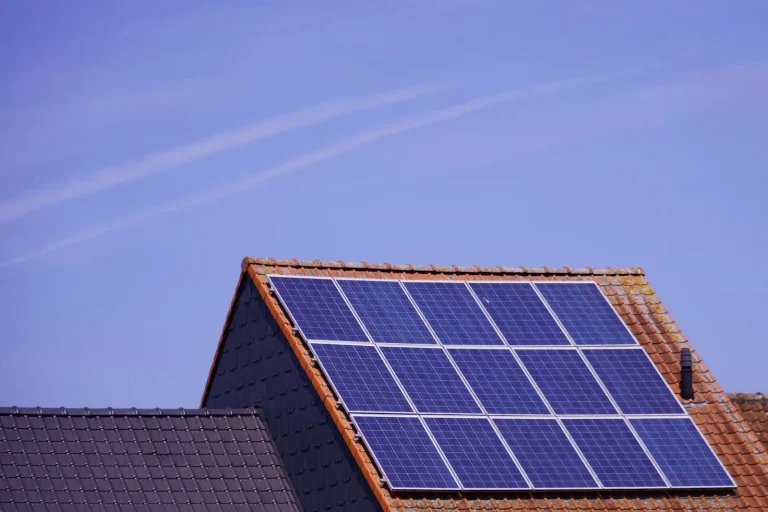
Bifacial panel collect light on the front and rear surfaces. Their benefit depends on rear-side irradiance. High ground clearance, reflective surfaces, row spacing, and limited rear shading can improve that opportunity. A flush-mounted array on dark asphalt shingles often has less rear-side light to use.
Ask an installer for a site-specific production model. The model should state the assumed rear-side gain, racking height, roof color or ground cover, row spacing, and shading. A proposal that claims a gain without these assumptions has not finished the comparison.
For a live proposal, compare model-specific front power, bifaciality factor, mounting height, and warranty data in the same worksheet. Do not substitute a generic percentage for that design review.
Which specifications predict output?
In 2026, residential monocrystalline modules commonly fall around 20%-23% efficiency and 400W-450W. Efficiency matters on a small roof. It does not predict annual production by itself.
Read the entire datasheet. The following numbers answer different questions:
| Specification | What it tells you | Why it matters |
|---|---|---|
| Rated power at STC | DC output under standard laboratory conditions | Useful for system sizing, but not annual kWh by itself |
| Module efficiency | Output per module area | Important when clear roof space is limited |
| Temperature coefficient | Power change as module temperature rises | Helps compare hot-weather behavior |
| Physical dimensions and weight | Roof area and handling demand | Can decide whether a layout fits |
| First-year and annual degradation | Warranted output retention | Defines the long-term production promise |
| Product and performance warranties | Defect and output remedies | Coverage, exclusions, labor, and issuer vary |
| Certification and listing | Compliance evidence for the exact model | Supports code, inspection, and procurement review |
The U.S. Department of Energy states that crystalline-silicon modules can have 25-plus-year lifespans and less than 1% annual power degradation. That is a technology-level context, not a substitute for the exact warranty attached to the model in a quote.
Efficiency is also not a quality score. Two modules can have similar efficiency but different temperature coefficients, mechanical ratings, warranties, dimensions, service support, and installed cost. Compare those values in matching units and test conditions.
For narrow product claims, ask for the exact rated power and compare the electrical datasheet. Neither a high wattage label nor a black appearance is a standalone quality signal.
Not sure which solar module is right for your project? Contact our engineers for a customized solution.
How should you compare quotes in 2026?
As of July 2026, the IRS states that the Residential Clean Energy Credit is unavailable for property placed in service after December 31, 2025. A 2026 homeowner comparison should therefore use the full installed cost unless a separate, verified state, utility, or local incentive applies.
Start with a one-page comparison sheet. Ask every installer to provide the same fields. If a value is missing, mark it as missing instead of guessing.
- System design: module model, module count, DC capacity, inverter model, roof planes, and production-model assumptions.
- Output estimate: expected annual kWh, shade inputs, orientation, temperature assumptions, and any claimed bifacial gain.
- Installed price: cash price, equipment price, roof work, permit work, electrical upgrades, financing terms, and exclusions.
- Warranty chain: product warranty, performance warranty, installer workmanship warranty, inverter warranty, who receives a claim, and labor coverage.
- Compliance and service: exact UL listing, applicable IEC documentation, utility interconnection responsibility, monitoring access, and RMA contact.
The right unit is not simply dollars per module. Use installed dollars per watt and, where assumptions match, expected annual kWh. Then read the scope. A low upfront price can omit roof repair, electrical work, monitoring, warranty labor, or a realistic shade model.
2026 policy check: The former 25D credit can be relevant to historic projects placed in service by December 31, 2025. It is not a discount to subtract from a newly placed 2026 homeowner system. This is not tax advice. Confirm current local incentives with the issuing authority and a licensed tax professional.
For roof-driven alternatives such as solar shingles, compare the complete roof scope, serviceability, output per usable area, and the party responsible for warranty claims.
What should installers and procurement buyers verify?
Procurement quality depends on traceable documents and service terms, not on a wattage claim or a single landed-price number.
Verify the exact model number on the quote, datasheet, label, packing list, certificate references, and warranty certificate. A near-match in family name is not enough. Check STC electrical ratings, temperature coefficient, dimensions, connectors, fire classification, mechanical-load claims, and compatibility with the system design.
For U.S. projects, ask the installer or engineering lead to verify the applicable listing and the authority having jurisdiction requirements. IEC 61215 and IEC 61730 documentation matters in a module review. Local code, utility, fire, structural, and permit requirements still need project-specific confirmation.
Procurement buyers should also confirm serial traceability, pallet configuration, minimum order quantity, lead time, Incoterms, freight insurance, duties treatment, warranty issuer, and the replacement-module process. A warranty is only useful when its issuer, response path, and geographic support are clear.
The best procurement question is often not “What is your price per watt?” It is “What evidence ties this delivered SKU to its test data, warranty remedy, and service owner?” That question exposes the gap between a quote and a supply commitment.
Which technologies are worth watching?
A home buyer should still choose a currently available module by certification, warranty, supplier support, and site fit.
Tandem designs layer materials with different bandgaps to capture different parts of the solar spectrum. They may improve efficiency potential. The practical questions are durability, manufacturing scale, certification, warranty, and replacement availability. A laboratory record does not answer those project questions.
HJT, IBC, glass-glass construction, and BIPV also have legitimate roles. They should be chosen for a stated constraint. A hot roof, a design-led building envelope, or a specific output-density need can justify a specialized option. Otherwise, a well-supported mainstream n-type mono module may be the lower-risk choice.
Frequently Asked Questions
What type of solar panel is best for a typical home?
For most homes, start with a certified monocrystalline n-type module and compare the exact datasheet, warranty, dimensions, and installed design. DOE says industrial silicon modules commonly reach 20%-22% real-world efficiency, but the best choice still depends on usable roof area, shade, temperature, and price.
Are TOPCon panels better than PERC panels?
TOPCon is the current mass-market baseline, not an automatic verdict. IEA PVPS reports its market share rose from 30% to 70% during 2024. Compare the offered module’s warranty, degradation terms, certification, and installed price before treating the cell label as a quality ranking.
Are bifacial solar panels worth it on a house?
Bifacial panels can be worthwhile when their rear side receives useful reflected or diffuse light. IEA PVPS reports bifacial modules made up 77.6% of Chinese production in 2024, but a flush array on dark shingles may capture little of that potential. Ask for a site-specific rear-side production assumption.
Is a higher-efficiency solar panel always better?
No. Higher efficiency helps a limited roof fit more capacity, but it does not replace a production model. EnergySage places many current residential mono modules in the 20%-23% efficiency range. Temperature behavior, shading, roof orientation, degradation, warranty, and installed cost still affect value.
How long do solar panels last?
Crystalline-silicon modules can last 25 years or more and show less than 1% annual power degradation, according to DOE. Read the exact product and performance warranty because coverage, labor treatment, degradation schedule, and the party handling a claim differ by manufacturer.
Can a homeowner claim a federal solar tax credit in 2026?
Not for property placed in service after December 31, 2025. The IRS says the Residential Clean Energy Credit is unavailable afterward. State, utility, and local incentives can differ by address and program, so verify them with the issuing authority and a licensed tax professional.
Do black solar panels produce more electricity?
Not necessarily. A black appearance usually reflects cell and module design choices, while output depends on the exact model’s rated power, efficiency, temperature coefficient, and operating conditions. DOE reports industrial silicon modules commonly operate in the 20%-22% efficiency range, so use the datasheet rather than color as the comparison metric.
Should I wait for perovskite or tandem solar panels?
Usually no, if a currently available design meets your needs. DOE reports perovskite lab efficiency improved from 3% in 2009 to more than 25% in 2020, but commercial buying decisions still require durability evidence, certification, warranty, and local availability.
Make the decision with a quote sheet, not a label
The best solar PV panel comparison starts with the site. Choose the material, architecture, and module construction that fit the roof and system design. Then verify the exact module documents, annual-production assumptions, warranty chain, certifications, and complete installed scope.
For many 2026 home projects, a certified monocrystalline n-type module is a practical baseline. Bifacial construction can add value in the right geometry. Thin film, flexible PV, and solar shingles fit more specialized constraints. No label replaces a project-specific design and an honest quote comparison.
Sources and reference records
- IEA PVPS, Trends in Photovoltaic Applications 2025
- U.S. Department of Energy, Crystalline Silicon Photovoltaics Research
- U.S. Department of Energy, Solar Photovoltaic Cell Basics
- Internal Revenue Service, Residential Clean Energy Credit
- EnergySage, Which Type Of Solar Panel Should You Choose?
Disclosures: Hongyu is a solar-panel manufacturer. This article applies neutral technical criteria and public sources to compare module categories. It is not electrical, structural, code, utility-interconnection, procurement, or tax advice. Electrical work and project design require qualified local professionals.
By Peter: Peter is a Senior PV & Energy Storage Engineer at Hongyu Supply Chain. As a seasoned expert in the renewable energy industry, he focuses on solar power generation, smart energy storage systems, and clean energy supply chains, delivering valuable technical analysis and industry trend insights to global audiences.