Solar Panel Wiring Issues: Diagnostic Guide & 2026 Repair Costs
Solar panel wiring issues cause roughly a quarter of warranty claims, and most start small enough to catch from the ground. This diagnostic from Hongyu walks the seven most common faults, from rodent damage to loose connectors and ground and arc faults, what each looks like in your monitoring app, and which ones require a licensed electrician.
Key Takeaways
- Solar panel wiring issues fall into 7 common patterns: rodent damage, water ingress, loose connections, ground faults, arc faults, corroded MC4 connectors, and aged junction boxes.
- Most are visible from a ground-level visual inspection or audible during system startup.
- DIY is safe for visual inspection and monitoring app diagnostics. DC wiring work requires a licensed electrician (NABCEP-certified preferred).
- Average repair cost as of May 2026: $300 to $1,200 for rodent-chewed wiring, $400 to $800 for MC4 connector replacement, $200 to $600 for ground-fault troubleshooting.
- The rapid shutdown device (NEC 690.12) catches the worst issues automatically. Test the button annually.
Table of Contents
- What are the most common solar panel wiring issues?
- The ground-level diagnostic routine
- Step 1: Pull per-panel data from your inverter app
- Step 2: Walk the conduit run
- Step 3: Inspect visible junction boxes and disconnects
- Step 4: Listen during startup
- Step 5: Check the rapid shutdown test
- Solar panel wiring issues: cost to repair in 2026
- How to prevent solar panel wiring issues
- When you must call an electrician immediately
- Frequently Asked Questions
- Can I fix solar panel wiring myself?
- How do I know if my solar panel has a wiring problem?
- What does it cost to fix solar panel wiring?
- How can I prevent solar panel wiring issues?
- What is an arc fault in solar panels?
- Are loose solar panel connectors dangerous?
- Can rodents really damage solar panel wiring?
- What is rapid shutdown and why does it matter?
- Sources and references
- Related guides
What are the most common solar panel wiring issues?
Field data from Hongyu and US installer surveys shows the same 7 issues account for the majority of wiring-related production losses:
| Issue | Frequency | DIY-detectable signal |
|---|---|---|
| Rodent-chewed conduit or cables | 35% | Sudden full-array shutdown; chew marks on visible conduit |
| Water ingress at junction box | 18% | One panel sudden underperformance; visible corrosion |
| Loose MC4 connector | 15% | Single panel intermittent output drops |
| Ground fault | 12% | Inverter error code GFCI / GFDI |
| Arc fault | 10% | Inverter error code AFCI; burn smell near junction box |
| Corroded grounding lug | 6% | Slow whole-array drift downward |
| Aged junction box seal | 4% | Visible browning or yellowing at junction box |
The ground-level diagnostic routine
Run this whenever your monitoring app flags a production drop. It takes 30 minutes and uses no special tools.
Step 1: Pull per-panel data from your inverter app
Most modern solar inverters report per-panel output. Open the app and look for:
- A single panel making 20%+ less than its siblings → suggests wiring or connector issue specific to that panel
- A string of 6 to 10 panels all making 0% → suggests upstream wiring fault or rodent damage on that string
- Whole-array drop with all panels even → suggests inverter fault, not wiring
Step 2: Walk the conduit run
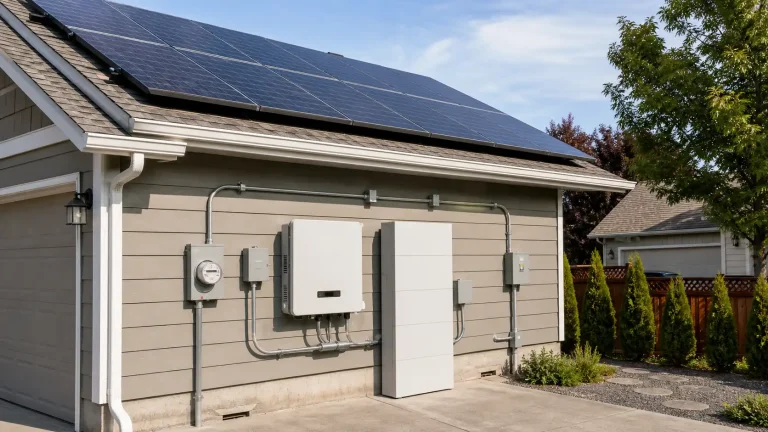
From the array on the roof down to the inverter and electrical panel, walk the entire conduit path. Look for:
- Chew marks on conduit (rodent damage)
- Sagging or pinched conduit (installer error or settling)
- Conduit pulled away from mounts (wind or thermal cycling)
- Discoloration or burn marks near junction boxes
- Water staining under conduit runs
Step 3: Inspect visible junction boxes and disconnects
Without opening any cover, look at the exterior of each junction box and DC disconnect:
- Browning, yellowing, or melting on the housing
- Visible corrosion at cable entries
- Loose mounting clamps
- Missing or damaged labels (NEC 690.13 requires legible labels)
Step 4: Listen during startup
When the inverter powers on in the morning, listen for:
- Loud crackling or buzzing (arc fault)
- Repeated clicking (relay cycling from ground fault)
- Burning smell near the inverter
Any of these is a service call, not a wait-and-see.
Step 5: Check the rapid shutdown test
Press the rapid shutdown test button (typically near the array or on the inverter). The inverter should drop to safe voltage within 30 seconds per NEC 690.12. If it does not, the safety system is compromised and needs immediate professional service.
For the full annual routine, see the maintenance checklist.
Solar panel wiring issues: cost to repair in 2026
Real US pricing as of May 2026:
| Issue | Repair cost | DIY-safe? |
|---|---|---|
| Rodent-damaged conduit run | $300–$1,200 | No, requires electrician |
| Single MC4 connector replacement | $200–$400 + electrician trip | No, DC work |
| Junction box water damage | $300–$700 | No, requires electrician |
| Ground fault troubleshooting | $200–$600 | No, requires electrician |
| Arc fault troubleshooting | $300–$800 | No, requires electrician |
| Critter guard installation (preventive) | $300–$500 | Yes, with installer help |
| Conduit re-securing (mounting only) | $100–$250 | Sometimes, no DC contact |
| Cable management cleanup | $150–$300 | Yes if no DC contact |
Note: All DC wiring work requires a licensed electrician with PV experience. NABCEP certification is the gold standard.
How to prevent solar panel wiring issues
Five practices catch 80% of wiring issues before they become production losses or fire risks:
- Install a critter guard at year 1. Galvanized mesh under the array perimeter prevents the most common cause of wiring damage. Cost: $300 to $500 once. Savings: $300 to $1,200 per rodent-damage event.
- Inspect conduit runs spring and fall. Visual only, from the ground. Look for chew marks, sagging, and discoloration.
- Update inverter firmware annually. Manufacturers patch arc-fault detection sensitivity and ground-fault thresholds. Schedule November of each year.
- Test rapid shutdown device annually. Push the button, confirm inverter drops voltage within 30 seconds.
- Photograph junction boxes yearly. Compare year-over-year for emerging corrosion or browning before it becomes a fault.
For the printable annual schedule, see annual maintenance checklist.
When you must call an electrician immediately
Five situations demand immediate action—do not delay:
- Burning smell anywhere near the array or inverter
- Visible smoke or scorch marks
- Whole-array shutdown that does not restart in the morning
- Inverter displaying GFDI, AFCI, or RAPID SHUTDOWN error codes that persist
- Animal contact with exposed wiring (squirrels, raccoons, etc. — both an animal welfare and electrical safety issue)
Find a certified electrician through your original installer’s service network.
Frequently Asked Questions
Can I fix solar panel wiring myself?
No, for any DC wiring work. Solar systems run at up to 600 VDC, more than enough to be fatal. Visual inspection and monitoring app diagnostics are DIY-safe. All actual wiring work requires a licensed electrician.
How do I know if my solar panel has a wiring problem?
Three signals: a single panel making 20%+ less than its siblings in your monitoring app, sudden whole-array shutdown, or inverter error codes (GFDI, AFCI, RAPID SHUTDOWN). Visual signs include chew marks on conduit, browning at junction boxes, and corrosion at cable entries.
What does it cost to fix solar panel wiring?
$300 to $1,200 for rodent-damaged wiring runs, $200 to $400 for single MC4 connector replacement, and $200 to $800 for ground-fault or arc-fault troubleshooting as of May 2026. Most issues require a licensed electrician.
How can I prevent solar panel wiring issues?
Install a critter guard ($300 to $500 one-time), inspect conduit runs spring and fall, update inverter firmware annually, test the rapid shutdown button yearly, and photograph junction boxes year over year.
What is an arc fault in solar panels?
An arc fault is uncontrolled electrical arcing in the DC wiring, usually from a loose connection, water-damaged conductor, or corroded junction box. Modern inverters detect arc faults and shut down automatically per NEC 690.11. If you see an AFCI code, do not reset — call an electrician.
Are loose solar panel connectors dangerous?
Yes. Loose MC4 connectors create arc fault risk and intermittent production losses. They are also a fire hazard. If your monitoring app shows intermittent drops on one panel, schedule an inspection.
Can rodents really damage solar panel wiring?
Yes. Rodent damage is the single most common solar wiring issue, accounting for roughly 35% of wiring-related warranty claims. The mitigation is a galvanized mesh critter guard installed at the array perimeter.
What is rapid shutdown and why does it matter?
Rapid shutdown is a NEC 690.12 requirement that DC voltage drops to safe levels within 30 seconds of a manual trigger or grid disconnect. It protects firefighters and emergency responders. Test the device annually as part of the maintenance checklist.
Sources and references
- NFPA (2023). NEC 2023 Article 690 (Solar PV), 690.11 (Arc Fault Protection), 690.12 (Rapid Shutdown), 690.13 (Labeling). https://www.nfpa.org/codes-and-standards/all-codes-and-standards/list-of-codes-and-standards/detail?code=70.
- NREL (2023). PV Module Reliability Benchmark and O&M Field Failure Analysis.
- NABCEP (2024). Certified PV Installation Professional Standards. https://www.nabcep.org/.
- UL (2017). UL 61730: PV module safety qualification. Retrieved 28 May 2026.
Related guides
- Solar Panel Maintenance Guide
- Annual Maintenance Checklist
- Solar Panel Degradation Rate
- Solar Power Maintenance Costs
By Peter: Peter is a Senior PV & Energy Storage Engineer at Hongyu Supply Chain. As a seasoned expert in the renewable energy industry, he focuses on solar power generation, smart energy storage systems, and clean energy supply chains, delivering valuable technical analysis and industry trend insights to global audiences.