Can Solar Panels Be Recycled? US Recovery Process & 2026 Costs
Can solar panels be recycled? Yes, crystalline silicon panels are 96% recoverable, and the US recycling network went national in 2023. This guide covers what gets recovered, the $20-to-$30-per-panel cost, the six states in US that now ban landfilling panels.
Key Takeaways
- Yes, solar panels are recyclable. Crystalline silicon panels (96% of US residential market) recover 96% of their mass.
- The SEIA national PV recycling network came online in 2023 with 14 partner facilities across the US.
- Collection cost: $20 to $30 per panel as of May 2026, often bundled with new installation at $0 to $10 net.
- Materials recovered: glass (65% by weight), aluminum frame (15%), silicon cells (5%), copper wiring (3%), back-sheet polymer (10%).
Table of Contents
- Are solar panels recyclable?
- What materials are recovered from solar panels?
- How much does solar panel recycling cost in 2026?
- How to recycle solar panels in 2026: 4-step process
- Step 1: Confirm the panels are at end of life
- Step 2: Disconnect and remove safely
- Step 3: Locate a SEIA partner facility
- Step 4: Transport or arrange pickup
- What happens to old solar panels that are not recycled?
- Frequently Asked Questions
- Are solar panels actually recyclable?
- How much does it cost to recycle solar panels?
- Where can I recycle solar panels near me?
- Is it illegal to throw solar panels in the trash?
- What materials are recovered from recycled solar panels?
- Can old solar panels be reused instead of recycled?
- How long until solar panels need recycling?
- Sources and references
- Related guides
Are solar panels recyclable?
Yes. The two dominant residential panel types have different processes but both recover the majority of their mass:
- Crystalline silicon panels (96% of US residential market, including all Hongyu solar panels): 96% mass recovery
- Thin-film panels (CdTe, CIGS): 90% mass recovery, with specialized cadmium handling
The recycling industry was constrained until 2023 because US panel volumes were too low to support dedicated facilities. With the first major wave of 2000s-era installations now reaching end of life, SEIA’s national network opened 14 facilities in 2023 to 2024 with combined capacity for 1.5 million panels per year.
What materials are recovered from solar panels?
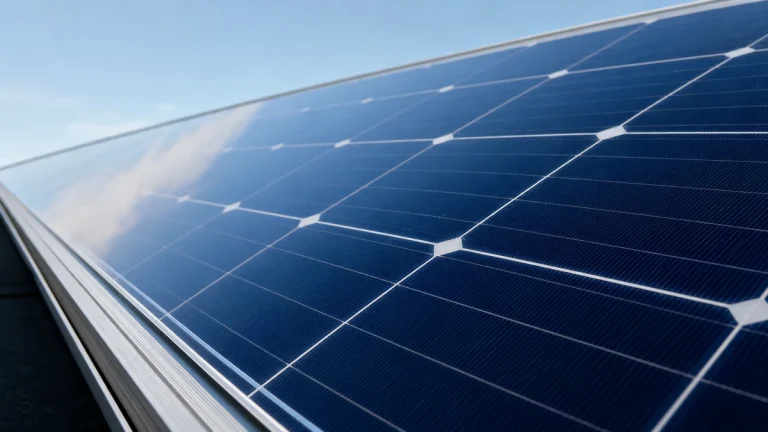
A typical residential solar panel weighs 40 to 50 lbs. The recovery streams by mass:
| Material | % by weight | Recovery process | Sold to |
|---|---|---|---|
| Tempered glass | 65% | Crushed, melted | Container glass, fiberglass |
| Aluminum frame | 15% | Separated, melted | Aluminum manufacturing |
| Back-sheet polymer | 10% | Pyrolysis or shredded | Plastic compound resellers |
| Silicon cells | 5% | Chemical separation | New cell wafers (closed loop) |
| Copper wiring + junction box | 3% | Manual separation | Copper foundries |
| Silver contacts | <1% | Acid leaching | Precious metals refiners |
| EVA encapsulant | 1% | Thermal or mechanical | Fuel pellets (energy recovery) |
The closed-loop silicon recovery is the most strategically important. Recovered silicon cells from end-of-life panels can be cast into new wafers, reducing the carbon footprint of new module manufacturing by 40 to 60% compared to mining-grade silicon.
How much does solar panel recycling cost in 2026?
Real US pricing as of May 2026:
| Pathway | Cost per panel | Logistics |
|---|---|---|
| SEIA partner facility drop-off | $20–$30 | You transport to nearest facility |
| SEIA partner pickup (residential) | $30–$45 | Curbside or driveway collection |
| Installer-bundled (with new install) | $0–$10 net | Installer handles disposal of old panels |
| Landfill disposal (where legal) | $5–$15 | Not recommended; banned in 6 states |
Six US states ban solar panels from municipal landfills as of 2026: California, Washington, North Carolina, Vermont, Hawaii, and New York. More states are expected to follow by 2028.
For the broader maintenance cost picture, see solar power maintenance costs.
How to recycle solar panels in 2026: 4-step process
Step 1: Confirm the panels are at end of life
Not every old panel needs recycling. Verify with these signals:
- Output below 70% of original rating (well below warranty floor)
- Visible damage (cracked glass, browning around cells, burn marks at junction box)
- Removal because of roof work, with intent to replace rather than reinstall
If panels are still producing 80%+ of rated output and physically intact, consider the secondary market via used solar panels for sale instead of recycling.
Step 2: Disconnect and remove safely
Hire an electrician for the disconnect. Removing live panels is a code violation and creates shock hazard. Cost: $200 to $500 for full system removal.
Step 3: Locate a SEIA partner facility
Use the SEIA recycling locator at https://www.seia.org/initiatives/recycling to find the nearest partner facility. As of May 2026, all 50 states have at least one accessible facility within 200 miles.
Step 4: Transport or arrange pickup
Most residential systems (20 to 30 panels) fit in a standard pickup truck. Wrap panels in cardboard or moving blankets to prevent glass breakage during transport.
For higher volumes (50+ panels from commercial removal), the SEIA network offers freight consolidation at reduced per-panel rates.

What happens to old solar panels that are not recycled?
Three landfill destinations are common but ill-advised:
- Municipal landfill (illegal in 6 US states): Heavy metals leach into soil over decades
- Construction debris facility: Allowed in most states but no material recovery
- Export to less-regulated markets: Common before 2023; SEIA network now displaces this
The carbon and metals footprint of unrecycled panels is substantially worse than the manufacturing cost of new panels. Recycling is the clear correct choice.
Frequently Asked Questions
Are solar panels actually recyclable?
Yes. Crystalline silicon panels recover 96% of their mass through the SEIA partner network. Thin-film CdTe panels recover 90% with specialized cadmium handling.
How much does it cost to recycle solar panels?
$20 to $30 per panel for drop-off at a SEIA partner facility as of May 2026. Pickup runs $30 to $45. Installer-bundled disposal with new installation is often $0 to $10 net.
Where can I recycle solar panels near me?
Use the SEIA recycling locator at seia.org/initiatives/recycling. All 50 US states have at least one accessible facility within 200 miles as of 2026.
Is it illegal to throw solar panels in the trash?
In six US states yes: California, Washington, North Carolina, Vermont, Hawaii, and New York. Other states currently allow landfill disposal but are expected to ban by 2028.
What materials are recovered from recycled solar panels?
Glass (65%), aluminum frame (15%), back-sheet polymer (10%), silicon cells (5%), copper wiring (3%), and trace silver. 96% of total mass for crystalline silicon panels.
Can old solar panels be reused instead of recycled?
Yes, if they still produce 80%+ of rated output. The secondary market for used residential panels is active, with prices at 20 to 40% of new. See used solar panels for sale.
How long until solar panels need recycling?
Most residential panels reach end of life around year 25 to 35. Replacement at this point is usually driven by efficiency arbitrage (new panels produce 50%+ more in the same roof space), not panel failure.
Sources and references
- Solar Energy Industries Association (2024). National PV Recycling Network status report. https://www.seia.org/initiatives/recycling.
- NREL (2023). PV Module End of Life Management.
- EPA (2024). Solar Panel Waste Management Guidelines. https://www.epa.gov/hw.
Related guides
- Solar Panel Maintenance Guide
- How Long Do Solar Panels Last?
- Solar Panel Degradation Rate
- Solar Power Maintenance Costs
Disclosures: Pricing reflects May 2026 US averages. Editorial reviewed by the Hongyu engineering team.
By Peter: Peter is a Senior PV & Energy Storage Engineer at Hongyu Supply Chain. As a seasoned expert in the renewable energy industry, he focuses on solar power generation, smart energy storage systems, and clean energy supply chains, delivering valuable technical analysis and industry trend insights to global audiences.