Solar Inverter Guide: How Panels, Batteries, and Mounts Work Together
Solar inverter choice decides how a home solar system turns panel output into usable AC power, manages shade, and connects to batteries or the grid. Hongyu is a Tier-1 solar module manufacturer, so this guide explains the full component stack from the module outward: solar panels, racking, wiring, inverter, lithium batteries, monitoring, and quote checks.
Key Takeaways
- A solar inverter converts DC electricity from panels into AC electricity a home can use.
- In 2024, module-level power electronics appeared in 87% of US residential systems in Berkeley Lab’s distributed solar dataset.
- Batteries are optional for many grid-tied homes, but they change inverter selection, backup design, and quote math.
- Racking and mounting affect roof penetrations, wind loading, inspection, service access, and long-term water risk.
- A good solar quote should show DC system size, AC inverter capacity, inverter type, module model, racking method, battery capacity, and warranty terms.
Table of Contents
- What Does a Solar Inverter Do?
- What Components Make Up a Home Solar System?
- String, Microinverter, Optimizer, and Hybrid Setups
- Do You Need Battery Storage With a Solar Inverter?
- How Do Panels, Cells, Modules, and Mounts Work Together?
- What Changes for Off-Grid, RV, Camper, and DIY Systems?
- How Do Component Choices Affect Cost and Maintenance?
- Solar Quote Checklist: What Each Component Line Means
- How Should You Start Planning a Solar Inverter System?
- Frequently Asked Questions
- What is a solar inverter?
- Is a solar inverter the same as a solar panel inverter?
- Can solar panels work without an inverter?
- Which is better, string inverter or microinverter?
- Do I need a battery with solar panels?
- What is the difference between a solar panel, module, and PV cell?
- Can I install solar inverter equipment myself?
- How long does a solar inverter last?
- Continue Learning
- Sources and References
What Does a Solar Inverter Do?
A solar inverter converts variable DC power from solar panels into AC power that matches household wiring and grid requirements. The inverter is the traffic controller for the electrical side of the system. It converts power, tracks the array’s best operating point, reports production, and helps the system shut down safely when the grid or equipment requires it.
Solar panels produce direct current, while homes use alternating current. Without an inverter, a normal grid-tied rooftop array cannot power standard home circuits. The inverter is also where several design decisions meet: roof shade, battery plans, monitoring detail, serviceability, and how much panel capacity can be paired with a given AC output rating.
In residential quotes, you may see string inverter, microinverter, power optimizer, hybrid inverter, or inverter/charger. Those are not cosmetic labels. They describe where conversion happens, how shade is handled, and whether storage can be added cleanly.
For homeowners, the practical question is not “Which inverter is best?” It is “Which inverter architecture fits this roof, this utility, this battery plan, and this service path?” A simple roof can be badly over-specified. A shaded roof can be under-specified. Both mistakes cost money.
What Components Make Up a Home Solar System?
In 2025, the DOE Solar Photovoltaic System Cost Benchmarks divided installed PV cost into module, inverter, energy storage, structural balance of system, electrical balance of system, fieldwork, office work, and other developer costs. That cost structure is a good map of the physical system.
A home solar system is not just panels on a roof. It is a set of components that must work electrically, structurally, and legally. The core parts are:
| Component | What it does | What to check in a quote |
|---|---|---|
| PV modules | Convert sunlight into DC electricity | Module model, wattage, efficiency, warranty |
| Racking and mounts | Attach modules to roof or ground structure | Roof attachment type, flashing, wind and snow rating |
| DC wiring and connectors | Move panel output toward inverter equipment | Conduit path, wire management, rapid shutdown scope |
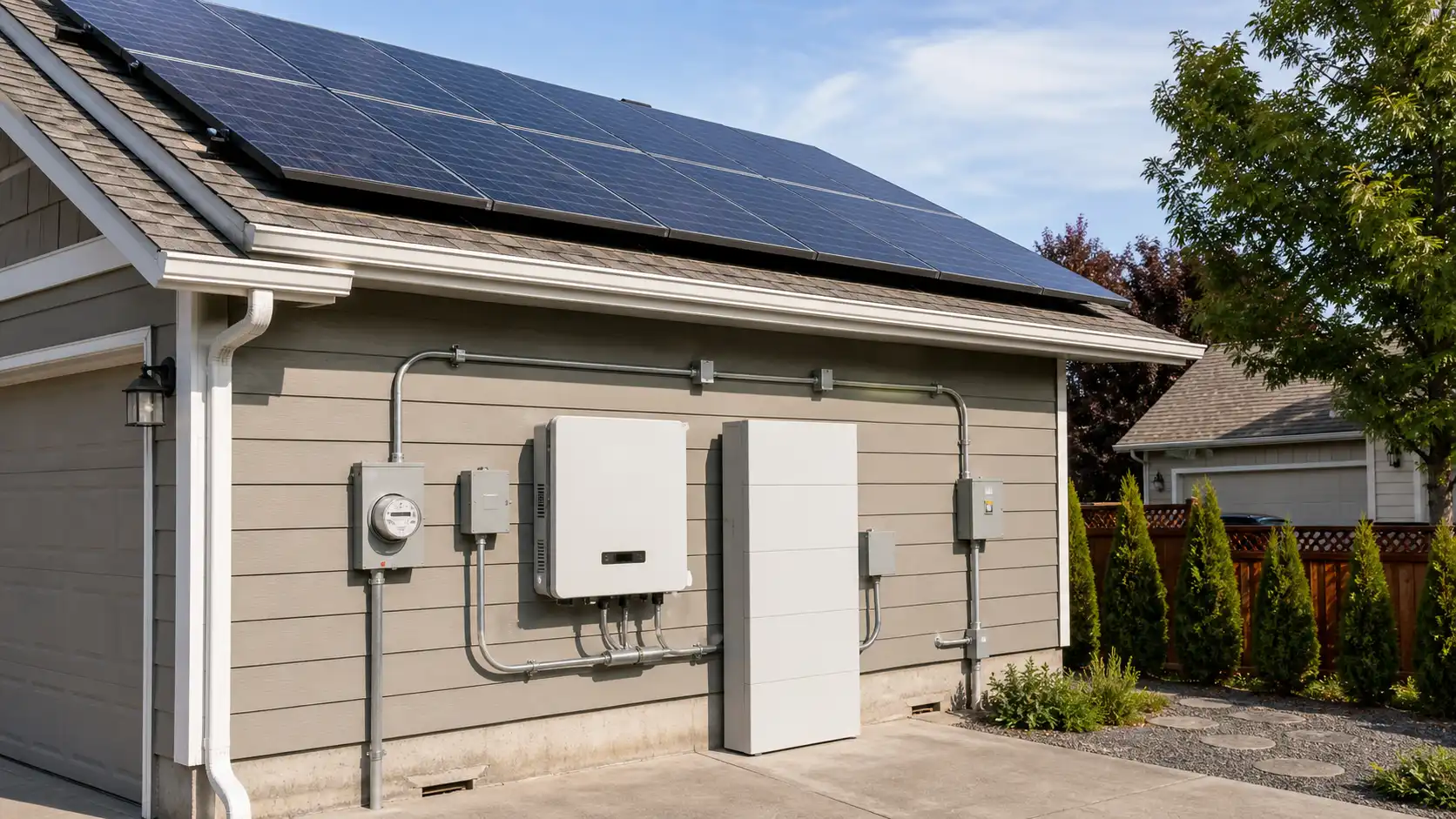
| Solar Inverter | Converts DC to AC and manages production | Type, AC rating, warranty, monitoring, battery readiness |
| AC electrical work | Connects solar output to home electrical system | Breaker work, disconnects, service panel upgrade if needed |
| Meter and interconnection | Connects the system to utility rules | Net metering or export rules, utility approval |
| Battery storage | Stores energy for backup or later use | kWh capacity, kW output, chemistry, warranty |
| Monitoring | Shows system production and faults | App access, panel-level data, alert responsibility |
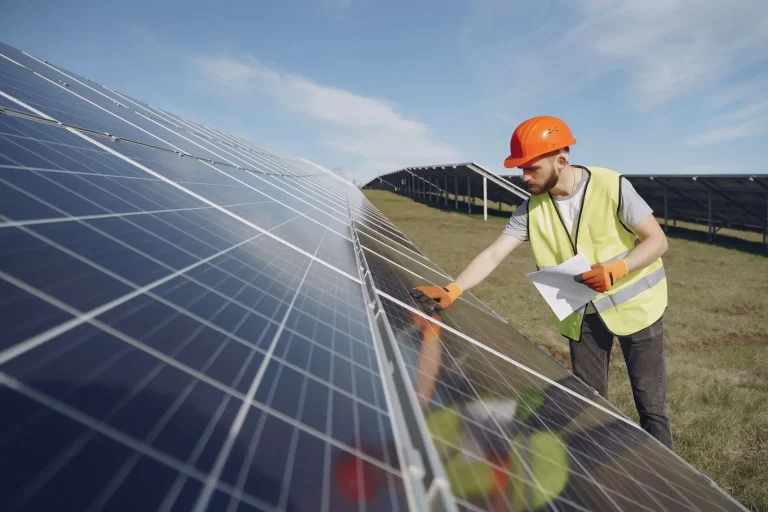
A home solar system is only as good as the way its parts work together. Panels produce DC power, the inverter converts it for household use, batteries store backup energy, and mounting hardware keeps the array secure. Understanding those relationships makes it easier to read a quote and spot mismatched equipment.
The DOE benchmark framework is useful because it separates hardware from fieldwork and office work. Panels and inverters matter, but permitting, interconnection, labor, and overhead are not afterthoughts. They are part of the system the homeowner pays for.
String, Microinverter, Optimizer, and Hybrid Setups
In 2024, Berkeley Lab reported that module-level power electronics, including microinverters and DC optimizers, were used in 87% of residential systems in its distributed solar dataset. That trend reflects real roof complexity: shade, multiple roof planes, monitoring expectations, and rapid-shutdown requirements.
Here is a simpler version for homeowners.
| Inverter setup | Best fit | Watch-outs | Battery note |
|---|---|---|---|
| String inverter | Simple roof, little shade, one main panel direction | One shaded panel can affect string output unless design accounts for it | Often pairs with DC-coupled storage through compatible hardware |
| String inverter with optimizers | Shaded or multi-plane roofs where panel-level control helps | Requires compatible equipment set | Often storage-friendly, depending on brand architecture |
| Microinverters | Complex roofs, panel-level monitoring, modular expansion | More electronics on the roof | Often AC-coupled for battery additions |
| Hybrid inverter | Solar plus battery planned from the start | Design must match battery voltage and backup loads | Strong option for storage-first designs |
| Off-grid inverter/charger | Cabins, remote homes, critical backup systems | Battery and load sizing dominate the design | Required for many stand-alone systems |
String inverters are mature, cost-controlled, and serviceable. They often make sense when the roof is simple and shade is minimal. Microinverters and optimizers make more sense when roof planes face different directions or nearby trees create uneven production. Hybrid inverters matter when battery storage is part of the first design, not a vague future wish.
Panel-level monitoring should be tied to roof complexity and service expectations, not just a sales pitch. It can isolate faults faster, but not every simple roof needs it.
The quote should show both DC system size and AC inverter capacity. PVWatts often uses a 1.2 DC-to-AC ratio as a baseline. For example, a 12 kW solar array may be matched with about a 10 kW inverter in many standard estimates. This is a useful point, but it is not a rule that applies to every roof, system, or utility requirement.
When Hongyu’s engineering team reviews module layouts with installer partners, the first inverter question is usually roof geometry, not brand. The inverter architecture follows the roof and storage plan. It should not be chosen before those constraints are clear.
Do You Need Battery Storage With a Solar Inverter?
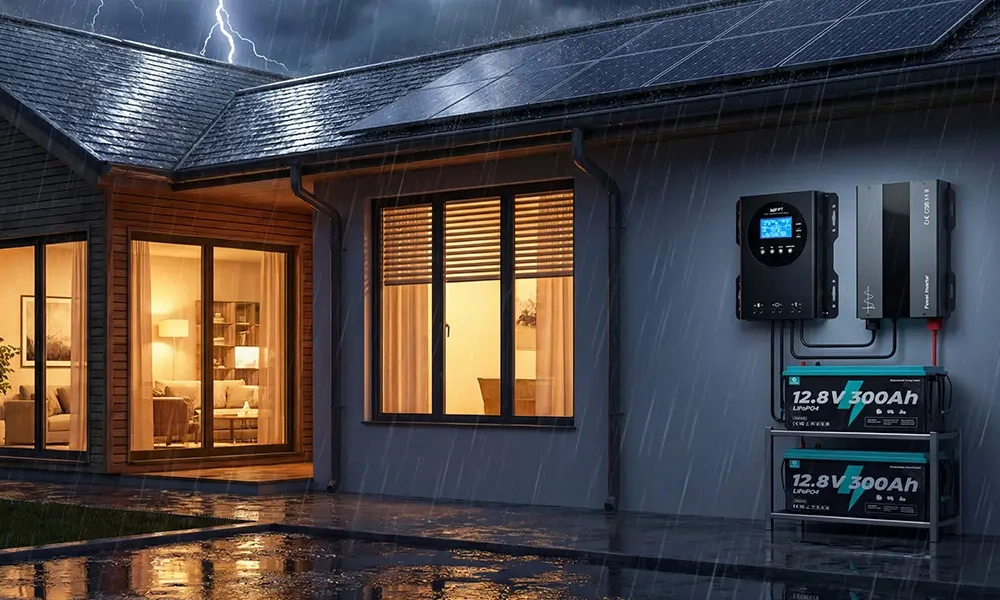
No, you do not always need battery storage with a solar inverter. A standard grid-tied solar system can work without a battery. During the day, the panels produce power, the inverter converts it, and the home uses what it can. Depending on utility rules, excess electricity may be exported. At night, the home simply uses grid power.
But when you add a battery, the system can do more. Instead of only using solar power during the day, the home can store extra energy and use it later. This can help with:
- Backup power during outages
- Higher self-consumption when export credits are weak
- Time-of-use bill management
- Off-grid operation
- Critical-load protection for medical devices, refrigeration, communications, or pumps
The inverter question changes with the battery question. Some systems use AC-coupled batteries, where the battery has its own inverter equipment. Others use DC-coupled or hybrid inverter designs, where solar and battery energy share a more integrated power path. Neither architecture is always better. The right answer depends on whether storage is added now, added later, or required for off-grid operation.
Battery sizing should start with loads, not product names. A “whole-home backup” promise can require much more battery capacity and electrical work than a critical-load panel.
The DOE homeowner guide describes storage as a way to use solar power when it is needed most, including after sunset or during an outage. That is the right framing. A battery is not a trophy accessory. It is an energy-use decision.
How Do Panels, Cells, Modules, and Mounts Work Together?
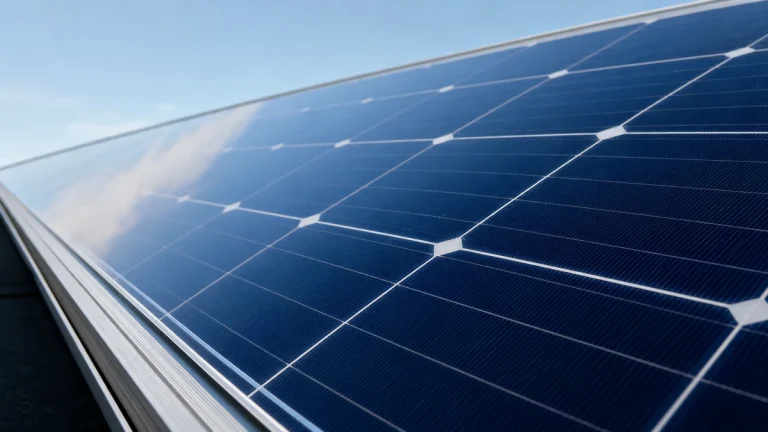
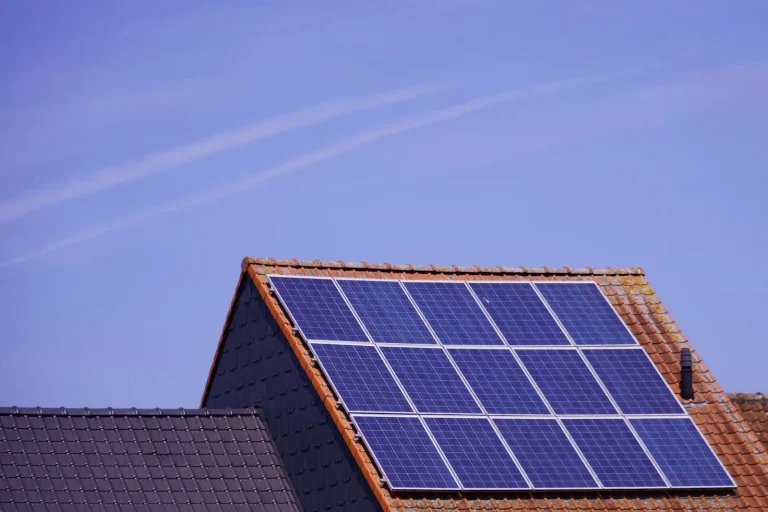
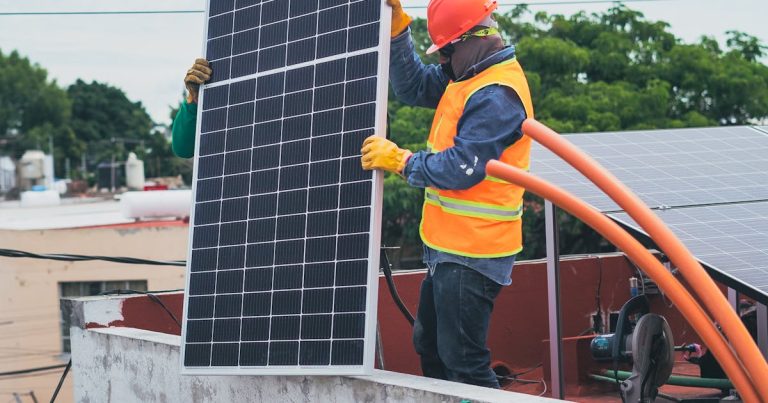
A home solar system starts with the smallest unit: the photovoltaic cell. Cells are wired together to form a module, and homeowners usually call that module a solar panel. Multiple panels are installed together as an array. The array produces DC power, and the inverter converts that power into AC electricity for the home.
Mounting hardware, also called racking, holds the array on the roof. It affects how panels are attached, sealed, grounded, wired, and serviced. In simple terms, panels produce the power, the inverter converts it, and the mounts keep the whole system safely positioned on the roof.
Module efficiency then affects how much DC capacity can fit into the available roof space. Berkeley Lab reported median residential module efficiency around 20.9% in 2024, up from 13.0% in 2003. Higher efficiency can help fit more capacity on a small roof, which may influence inverter sizing and racking layout.
Here is the simple chain:
- Solar cells create DC electricity.
- Modules package cells into durable roof-ready units.
- Racking attaches modules to the structure.
- Wiring moves DC output safely.
- Inverter equipment converts DC to AC.
- The electrical panel, meter, and utility interconnection route power to the home and grid.
- Optional batteries store energy for later use.
As a solar module manufacturer, Hongyu pays close attention to the first two steps. But a good system depends on every step after the module, especially inverter and racking choices. A premium module installed with poor wire management or a bad roof attachment is not a premium system.
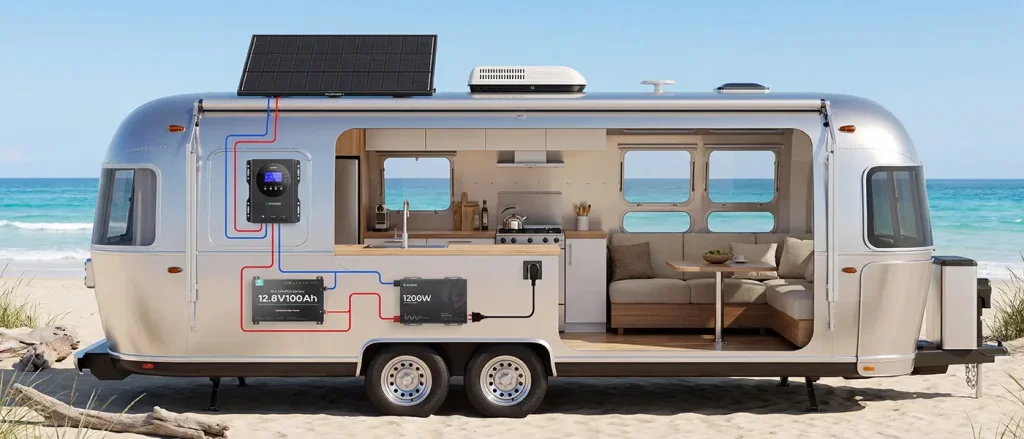
What Changes for Off-Grid, RV, Camper, and DIY Systems?
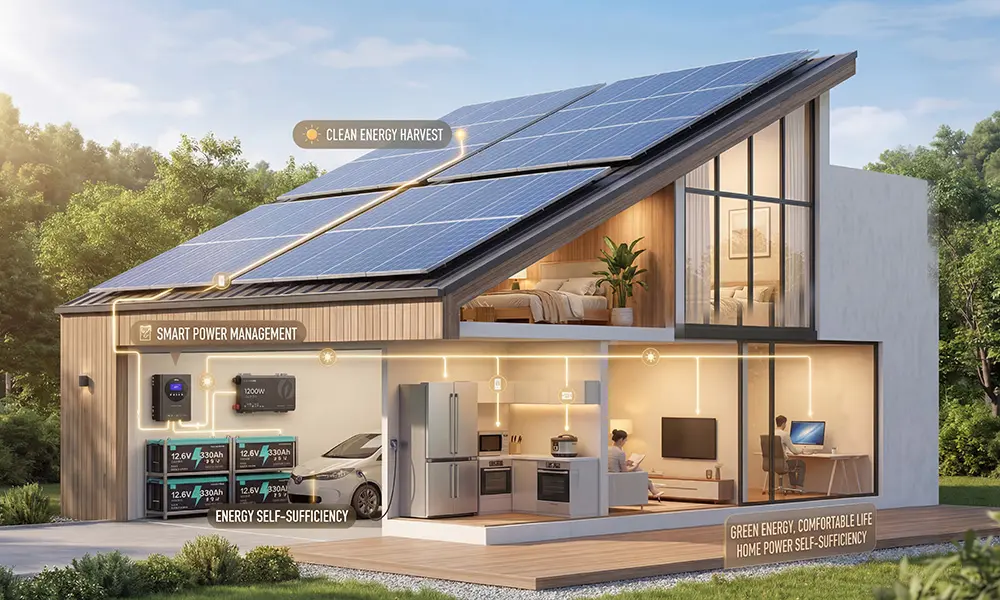
Off-grid, RV, camper, and DIY solar systems are planned differently from a standard grid-tied home system. A grid-tied rooftop system is usually designed around annual energy offset, utility rules, and roof production. Off-grid and mobile systems start with load survival: what must run, for how long, and at what surge power?
That is why batteries, inverter/charger sizing, charge controllers, wiring protection, and backup charging become more important in these systems. The question is not only how much solar power the panels can produce, but whether the system can keep essential loads running when there is no grid available.
DOE’s homeowner guidance still points readers toward qualified solar professionals and notes NABCEP as an industry-standard installer certification. That advice matters even more when batteries, off-grid loads, and inverter surge capacity enter the system.
An off-grid system usually needs:
- Solar panels sized for daily and seasonal energy needs
- Charge control or hybrid inverter equipment
- Battery capacity for night and cloudy periods
- Inverter output sized for continuous and surge loads
- Backup generator or secondary charging plan in many climates
- Careful wiring, protection, and disconnect design
RV and camper systems are smaller, but the same logic applies. A 100 watt panel can help maintain batteries or run light loads. It is not a whole-home power plant.
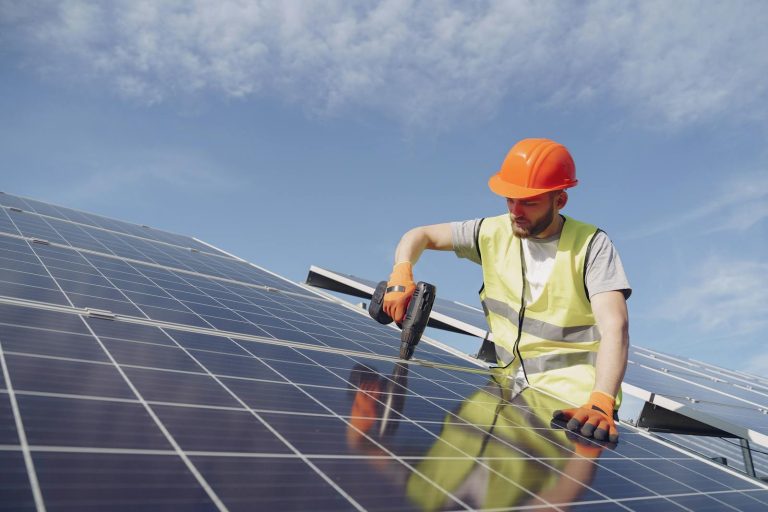
DIY kits can be useful for education, sheds, RVs, and low-voltage projects. They are a bad place to improvise with home interconnection, service panels, high-voltage DC strings, or code-required shutdown equipment. Hongyu Solar’s warranty position is straightforward: grid-tied home systems should be installed by qualified professionals and comply with local code, utility rules, and manufacturer instructions.
The inverter is the dividing line between a small solar charging project and a system that can power household AC loads. Once AC loads, batteries, and grid interconnection appear, the design deserves professional review.
How Do Component Choices Affect Cost and Maintenance?
In 2026, Berkeley Lab reported a median installed price of $4.0/Wdc for host-owned, PV-only residential systems in its sample, with wide variation across projects. Component choices matter, but so do financing, labor, permitting, and local market conditions.
The mistake is assuming that “solar cost” means only panel cost. Panels are the most visible part of the system, but the installed price also includes inverters, mounting hardware, wiring, electrical work, permitting, design, inspection, and installer labor.
Berkeley Lab also reported that soft costs and other balance-of-system costs made up roughly 80% of the total installed price of residential systems in 2026. That is why choosing a cheaper module alone does not automatically make the whole system cheap.
Still, component choices affect long-term ownership:
- Modules: output, warranty, efficiency, degradation, roof density
- Inverter: monitoring, shade behavior, battery compatibility, service path
- Battery: backup scope, replacement cost, operating mode
- Racking: roof integrity, wind loading, service access
- Wiring and protection: inspection, safety, fault isolation
- Monitoring: speed of detecting underperformance
Maintenance also differs by component. Modules usually need low-touch inspection and occasional cleaning in dusty areas. Inverters are electronic equipment, so heat, location, ventilation, and warranty terms matter. Batteries need software settings, temperature limits, and clear expectations for backup duration.
The system’s most expensive future problem is often not a bad panel. It is a mismatch: battery added to a non-storage-ready design, inverter placed in a hot location, roof work done without clear flashing responsibility, or a quote that hides electrical upgrades until late in the project.
Solar Quote Checklist: What Each Component Line Means
In 2026, DOE advises homeowners to obtain at least three bids and make sure those bids use the same characteristics and metrics for comparison. The best way to do that is to read the quote as a component map, not just a total price. Each line should tell you what equipment is included, how it affects system performance, and whether two quotes are actually offering the same thing.
Ask for these line items before you sign:
| Quote line | Why it matters | Question to ask |
|---|---|---|
| DC system size | Determines panel capacity | How many modules and what wattage? |
| AC inverter capacity | Determines conversion output | What is the DC-to-AC ratio? |
| Inverter type | Affects shade, monitoring, batteries | Why this architecture for my roof? |
| Module model | Affects efficiency and warranty | Is the exact datasheet attached? |
| Racking method | Affects roof risk | What attachment and flashing system is used? |
| Battery capacity | Affects backup duration | Is this whole-home or critical-load backup? |
| Electrical scope | Affects final price | Is a panel upgrade included or excluded? |
| Monitoring | Affects fault detection | Who receives alerts and who responds? |
| Warranties | Affects service expectations | Product, performance, workmanship, labor? |
| Financing fees | Affects real price | What is the cash price before loan fees? |
If two quotes show the same total price, they can still be very different systems. One may include microinverters, better racking, a panel upgrade, and clearer workmanship coverage.
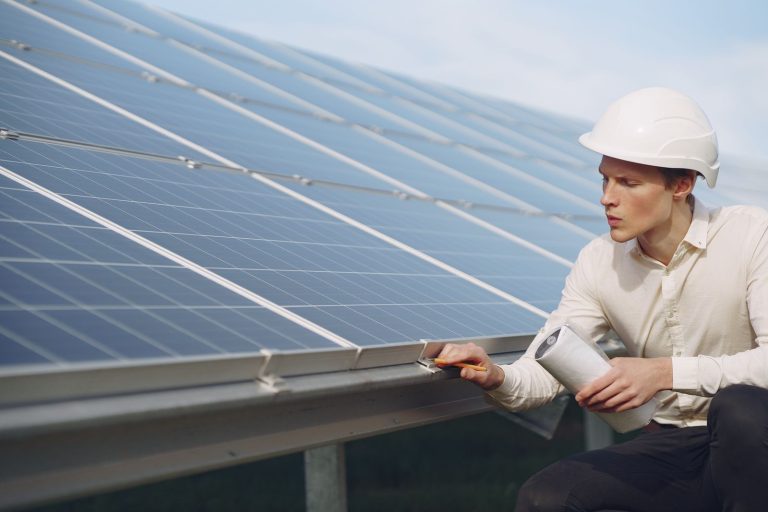
The inverter line deserves special attention. Look for manufacturer, model, AC rating, warranty length, monitoring capability, battery compatibility, and service location. If the quote only says “inverter included,” ask for the model. If it says “battery ready,” ask what battery architecture and additional equipment are required.
The same is true for racking. A quote should name the mounting system or at least specify attachment method, flashing approach, roof type assumptions, and whether roof warranty issues are handled. Water intrusion risk is not solved by a good panel datasheet.
Finally, compare cash price before financing. Loan dealer fees can make two systems look similar monthly while hiding very different upfront economics.
How Should You Start Planning a Solar Inverter System?
From Hongyu’s experience, the best starting point is the home, not the inverter. Review your electricity bills, roof conditions, future load changes, battery plans, and local interconnection rules first. Then choose an inverter architecture that fits those conditions. This order helps avoid expensive mismatches between panel capacity, inverter size, battery compatibility, and utility requirements.
Use this first-pass path:
- Collect 12 months of utility bills. Note annual kWh, peak summer use, and rate plan.
- List future loads. EV charging, heat pumps, additions, pool pumps, and mini splits can change system size.
- Map the roof. Note shade, roof age, roof material, directions, and usable area.
- Decide whether backup matters. If yes, list critical loads before discussing battery brands.
- Ask for a component-level quote. Require module, inverter, racking, battery, and electrical details.
- Compare on cash price and scope. Do not compare only monthly payment.
For a simple unshaded roof, you may not need the most complex inverter setup. For battery backup, hybrid or storage-ready architecture should be discussed before the permit set is drawn.
Hongyu’s role as a module manufacturer gives us a strong opinion on one point: module quality matters, but system quality is broader than module quality. The best homeowner outcome comes from pairing certified modules with the right inverter architecture, code-compliant racking, clean wiring, and an installer who documents the scope clearly.
If you are sourcing modules directly, ask whether the installer will perform a labor-only or owner-supplied-equipment installation before buying equipment.
Frequently Asked Questions
What is a solar inverter?
A solar inverter converts the direct current (DC) electricity from solar panels into alternating current (AC) electricity used by home circuits. It is the part of a solar power system that makes solar energy usable for standard household electricity.
Is a solar inverter the same as a solar panel inverter?
Yes. A solar inverter and a solar panel inverter usually mean the same thing: the equipment that converts DC electricity from solar panels into AC electricity for home use. In quotes, the exact inverter type may be listed as a string inverter, microinverter, or optimizer-based system.
Can solar panels work without an inverter?
Yes, solar panels can produce DC electricity without an inverter. However, most home solar systems need an inverter to convert that DC power into AC electricity for household circuits and grid connection.
Which is better, string inverter or microinverter?
Neither string inverters nor microinverters are always better. A string inverter is often a good fit for a simple, unshaded roof, while microinverters are often better for shaded roofs, complex roof layouts, or systems that need panel-level monitoring. The right choice depends on roof shape, shade, monitoring needs, battery plans, and budget.
Do I need a battery with solar panels?
No, many grid-tied solar panel systems work without batteries. A battery is useful when you want backup power, better control under time-of-use electricity rates, or off-grid operation. For a standard home connected to the utility grid, battery storage is optional, not required.
What is the difference between a solar panel, module, and PV cell?
A PV cell is the small electricity-producing unit inside a solar product. Multiple cells are wired together to form a module, and homeowners often call that module a solar panel. In simple terms, cells make up modules, modules are called panels, and multiple panels form a solar array.
Can I install solar inverter equipment myself?
For a grid-tied home solar system, inverter installation should usually be handled by qualified professionals. Solar inverters involve DC wiring, AC circuits, service panels, disconnects, batteries, and utility interconnection rules. Incorrect installation can create safety risks and code problems.
How long does a solar inverter last?
A solar inverter’s lifespan depends on the inverter type, heat exposure, installation quality, maintenance, and warranty terms. In many residential systems, inverter warranties are listed separately from solar panel warranties. Homeowners should ask for the inverter model, warranty length, and replacement terms in writing before signing a solar quote.
Continue Learning
System components:
- Battery Storage: Everything You Need to Know
- Off-Grid Solar System Guide
- Solar Panel Mounting Brackets and Racking
- Photovoltaic Cell Basics
- DIY Solar Kits
- Solar Power Generators
Related blogs:
- Solar panel installation cost
- Solar panel maintenance
- Types of residential solar panels
- Solar panel efficiency
The main takeaway is simple: choose the inverter after you understand the roof, battery plan, and electrical work involved. Panels produce the power. Mounts hold the array. Batteries store extra energy. The inverter turns that solar power into usable home electricity.
Sources and References
- DOE, Solar Photovoltaic System Cost Benchmarks
- NLR, Q1-2025 Solar Photovoltaic System Cost Benchmarks
- NLR, PVWatts V8 API
- NLR, PVWatts Calculator
- Berkeley Lab, Distributed Solar and Storage 2025 Data Update
- DOE, Homeowner’s Guide to Solar
Hongyu Solar is a Tier-1 solar module manufacturer. This article explains system components from a PV modules manufacturer perspective and cites third-party public data for market, cost, and adoption claims. Electrical work should be designed and installed by qualified professionals according to local code, utility rules, and manufacturer instructions.
By Peter: Peter is a Senior PV & Energy Storage Engineer at Hongyu Supply Chain. As a seasoned expert in the renewable energy industry, he focuses on solar power generation, smart energy storage systems, and clean energy supply chains, delivering valuable technical analysis and industry trend insights to global audiences.