Best Solar Panel Cleaning Solutions & Tools 2026 (Tested Categories)
For 90% of homeowners, the best solar panel cleaning solution is plain deionized water — no soap, no specialty product. Hongyu Solar sells modules, not cleaners, so this guide ranks the five product categories purely by what works without voiding a warranty, and names the household products that quietly damage panels.
Key Takeaways
- The best solar panel cleaning solution for most homeowners is deionized or distilled water, nothing added.
- A $50 kit (soft brush, telescoping pole, deionized water) covers 90% of residential cleaning needs.
- Never use dish soap, Windex, vinegar, or any surfactant. Residue streaks the glass and accelerates re-soiling.
- For bonded grime (sap, bird droppings, hard-water spots), use a pH-neutral, surfactant-free solar-specific cleaner.
- Tap water above 100 ppm TDS leaves mineral spots that reduce output 1 to 3%. Test once with a $12 TDS meter.
Table of Contents
- What is the best solution to clean solar panels?
- The 5 categories of solar panel cleaning solutions (ranked)
- 1. Deionized / distilled water (best for 90% of homeowners)
- 2. pH-neutral surfactant-free solar cleaner (for bonded grime)
- 3. Soft-bristle brushes and tools (the mechanical half)
- 4. Isopropyl alcohol (spot treatment only)
- 5. Commercial cleaning robots (for large or hard-to-reach arrays)
- What you should NEVER clean solar panels with
- The best DIY solar panel cleaning kit (under $50)
- How to choose a solar panel cleaning solution for your situation
- Do you need a special solution, or is water enough?
- Frequently Asked Questions
- What is the best thing to clean solar panels with?
- Can I use soap to clean solar panels?
- What soap is safe for solar panels?
- Can I use vinegar to clean solar panels?
- What is the cheapest way to clean solar panels?
- Do I need deionized water to clean solar panels?
- Are solar panel cleaning robots worth it for homes?
- What is the best brush for cleaning solar panels?
- Will the wrong cleaning solution void my warranty?
- Sources and references
- Related guides
What is the best solution to clean solar panels?
Deionized or distilled water. For most residential systems in most climates, that is the entire answer.
Solar panels get dirty from three things: dust, pollen, and bird droppings. All three rinse off with water and a soft brush. Adding soap or chemicals creates a film that attracts more dust on the next dry cycle. The cleaning industry sells specialty solutions, but the 2013 UC San Diego soiling research and our own warranty data both point to the same conclusion: water plus mechanical action removes the dirt, and additives mostly create problems.
The exception is bonded grime. Sap, dried bird droppings, and mineral spots from hard water need a targeted cleaner, covered below.
The 5 categories of solar panel cleaning solutions (ranked)
1. Deionized / distilled water (best for 90% of homeowners)
- What it is: Water with minerals removed, leaving no spots on the glass
- Cost: $8 to $12 for a 5-gallon jug, or $150 to $300 for a home deionization filter
- Use case: Every routine cleaning, especially the final rinse
- Why it ranks first: Zero residue, zero warranty risk, removes 90% of soiling with a soft brush
If your tap water is below 100 ppm TDS, you can use it directly. Above 100 ppm, finish with deionized water to prevent mineral spots that reduce output 1 to 3%.
2. pH-neutral surfactant-free solar cleaner (for bonded grime)
- What it is: Purpose-formulated cleaners that lift sap and droppings without leaving film
- Cost: $15 to $30 per concentrate bottle (makes 5 to 10 gallons diluted)
- Use case: Sap, dried bird droppings, industrial fallout, hard-water spots
- What to look for on the label: “pH neutral,” “surfactant-free,” “no-residue,” “PV-safe”
- What to avoid: Anything listing “anionic surfactants,” fragrance, or dye
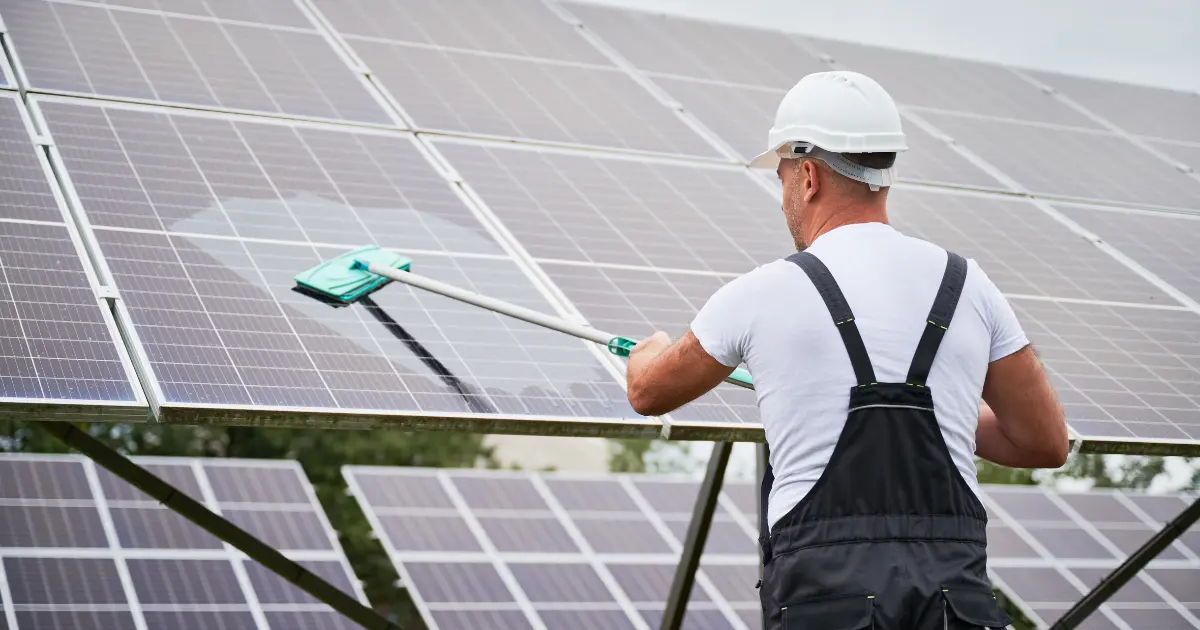
3. Soft-bristle brushes and tools (the mechanical half)
The solution only works with the right brush. Ranked by use:
| Tool | Cost | Best for |
|---|---|---|
| Telescoping water-fed pole (15–22 ft) | $60–$120 | Ground-level rooftop cleaning |
| Soft solar-specific brush head | $25 | Attaches to pole; the workhorse |
| Microfiber mop head | $8 | Stubborn spots, bird droppings |
| TDS meter | $12 | Confirm if you need deionized water |
4. Isopropyl alcohol (spot treatment only)
- What it is: 70% IPA for localized sticky residue (sap, adhesive)
- Cost: $5 to $8 per bottle
- Use case: Spot-treat a single sticky mark, then rinse with water
- Caution: Never apply to a whole panel or in direct sun. Spot use only.
5. Commercial cleaning robots (for large or hard-to-reach arrays)
- What it is: Robotic brush systems that clean solar panels as they move across the array
- Cost: $500 to $2,000
- Use case: Rarely cost-effective for residential; designed for utility-scale
- Verdict: Skip for homes. The cleaning is too infrequent to amortize the cost.
What you should NEVER clean solar panels with
These common household products damage panels and void Tier-1 warranties, including Hongyu solar panels:
| Product | Why it fails |
|---|---|
| Dish soap (Dawn, etc.) | Surfactant residue streaks glass, attracts dust, accelerates re-soiling |
| Glass cleaner (Windex) | Ammonia and surfactants leave film; some attack EVA encapsulant |
| Vinegar | Acidic; degrades the EVA encapsulant and seals over time |
| Abrasive powders (Comet, Bar Keepers Friend) | Scratches the anti-reflective coating permanently |
| Pressure washer (above 1,500 PSI) | Lifts panel seals, forces water under the frame, voids warranty |
| Hard tap water alone (above 100 ppm TDS) | Mineral spots reduce output 1 to 3% |
| Car wash soap | Wax additives create a haze that reduces light transmission |
For a complete overview of solar panel cleaning best practices, warranty considerations, and maintenance recommendations, see our guide: Solar Panel Cleaning: When, How, and Whether It’s Worth It.
The best DIY solar panel cleaning kit (under )
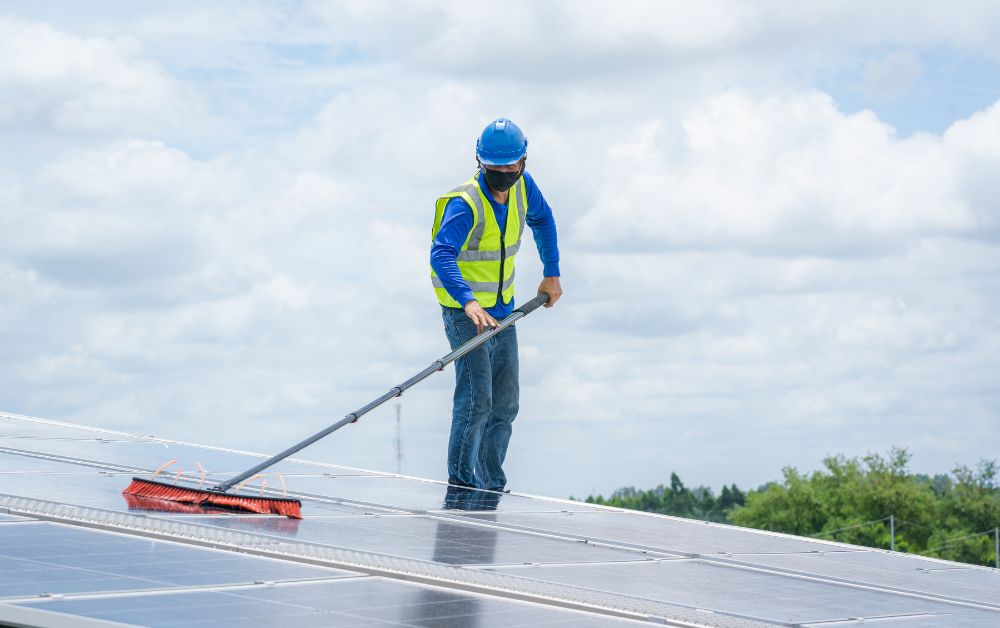
For a single-story home with low roof pitch, this kit handles every cleaning for 20+ years:
| Item | Cost |
|---|---|
| Soft solar brush head | $25 |
| Garden hose flow nozzle (likely owned) | $0–$10 |
| 5-gallon deionized water jug | $8–$12 |
| TDS meter (one-time) | $12 |
| Total | $45–$59 |
For the step-by-step routine using this kit, see how to clean solar panels. For rooftop-specific safety, see how to clean rooftop solar panels.
How to choose a solar panel cleaning solution for your situation
| Your situation | Recommended solution |
|---|---|
| Routine dust and pollen | Deionized water + soft brush |
| Hard tap water (above 100 ppm TDS) | Tap rinse + deionized final rinse |
| Bird droppings (fresh) | Deionized water + microfiber, within a week |
| Bird droppings (dried, bonded) | pH-neutral solar cleaner + soft brush |
| Tree sap | 70% IPA spot treatment + water rinse |
| Wildfire ash | Gentle deionized rinse within 30 days |
| Industrial / agricultural film | pH-neutral solar cleaner; consider a pro |
When in doubt, start with the gentlest option (plain water) and escalate only if the grime does not lift.
Do you need a special solution, or is water enough?
Water is enough for the large majority of cleanings. Reach for a specialty cleaner only when plain water plus a soft brush fails to lift bonded grime after two passes. Over-buying cleaning products is the most common homeowner mistake in this category. It costs money and risks residue.
For a deeper look at whether cleaning is even necessary, see do solar panels need to be cleaned?.
Frequently Asked Questions
What is the best thing to clean solar panels with?
Deionized or distilled water plus a soft-bristle brush. This handles 90% of residential cleaning with zero warranty risk and zero residue.
Can I use soap to clean solar panels?
No. Dish soap, glass cleaner, and car wash soap all leave surfactant residue that streaks the glass and accelerates re-soiling. Some also attack the EVA encapsulant. Use plain deionized water.
What soap is safe for solar panels?
None of the common household soaps. If water alone will not lift bonded grime, use a pH-neutral, surfactant-free, PV-safe solar cleaner instead of any soap.
Can I use vinegar to clean solar panels?
No. Vinegar is acidic and degrades the EVA encapsulant and seals over time. Plain water plus a soft brush is safer and just as effective for normal soiling.
What is the cheapest way to clean solar panels?
A garden hose plus a $25 soft brush, with a $8 to $12 jug of deionized water for the final rinse if your tap water is hard. Total under $50.
Do I need deionized water to clean solar panels?
Only if your tap water exceeds 100 ppm TDS. Test once with a $12 TDS meter. Below 100 ppm, tap water rinses clean. Above 100 ppm, finish with deionized water to avoid mineral spots.
Are solar panel cleaning robots worth it for homes?
No. Robots cost $500 to $2,000 and are designed for utility-scale arrays cleaned weekly. Residential systems are cleaned 2 to 4 times per year, too infrequently to justify the cost.
What is the best brush for cleaning solar panels?
A soft-bristle, solar-specific brush head (about $25) on a telescoping water-fed pole (about $60 to $120). Never use stiff bristles, metal brushes, or scouring pads.
Will the wrong cleaning solution void my warranty?
Yes. Pressure washing, abrasive powders, and some chemical cleaners void Tier-1 warranties including Hongyu solar panels. Stick to deionized water or a labeled PV-safe cleaner.
Sources and references
- Jacobs School of Engineering, UC San Diego (2013). Residential Solar Soiling Study. Retrieved 28 May 2026.
- NREL (2023). PV Module Reliability Benchmark. Retrieved 28 May 2026.
- IEC (2021). IEC 61215: Terrestrial PV modules. https://webstore.iec.ch/en/publication/61345. Retrieved 28 May 2026.
- Hongyu Solar (2026). Hongyu Solar Panels Limited Warranty, Section 4.2 (approved cleaning methods). Retrieved 28 May 2026.
Related guides
- Solar Panel Cleaning Guide
- How to Clean Rooftop Solar Panels Safely
- Best Solar Panel Cleaning Companies 2026
- Do Solar Panels Need to Be Cleaned?
- Solar Panel Maintenance Costs
About the Author & Disclosures:
By Peter: Peter is a Senior PV & Energy Storage Engineer at Hongyu Supply Chain. As a seasoned expert in the renewable energy industry, he focuses on solar power generation, smart energy storage systems, and clean energy supply chains, delivering valuable technical analysis and industry trend insights to global audiences.
Editorial Declarations:
- Company Focus: Hongyu Supply Chain is a dedicated photovoltaic module manufacturer. We do not provide solar panel cleaning services, nor do we sell any cleaning products.
- Independence: No brand has paid for placement or endorsement in this guide. All pricing information for solar panel cleaning services is sourced strictly from independent, third-party data.
- Financial Disclaimer: This article does not constitute financial or tax advice and is intended for informational purposes only based on third-party market data.